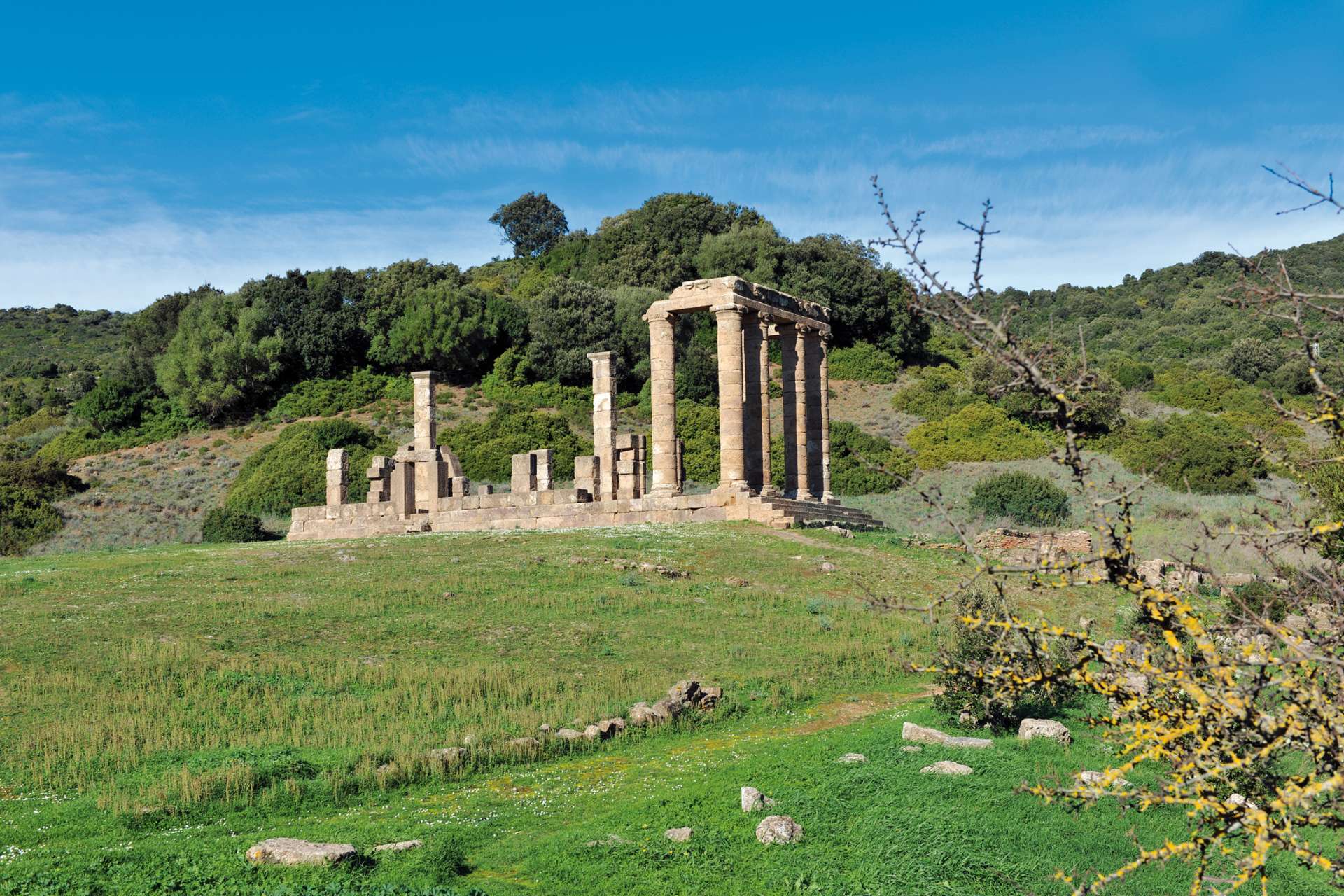
The Valley of Antas is nestled in the center of a beautiful natural amphitheater where the Temple of Antas "Roman", unique of its kind in Sardinia, stands.
The importance of the Archaeological site lies in the remains of the Roman place of worship, but tracing its history we find evidence of a Nuragic village that attests to the presence of civilization since the Bronze Age.
It was the Nuragic people who first used the Valley of Antas as a sacred place for cremation burials. Three pit tombs from the Iron Age (late Nuragic period) have been found, with a funerary typology that recalls few other examples in Sardinia.
Among the finds discovered are gold necklace beads, pendants, a ring, a silver vase completely covered in gold, and a bronze statuette that could represent the oldest depiction of Sardus Pater Babai.
Below the access steps to the "Roman" Temple of Antas are visible the remains of the Carthaginian place of worship (500 BC), erected in honor of the Punic deity Sid Addir Babay, considered by some scholars to be the indigenous god worshiped in the nearby Nuragic sanctuary. In the small shrine a series of dedicatory inscriptions were found, constituting an unparalleled heritage compared to any Punic colony in the entire West.
The Temple of Antas "Roman", mentioned by the famous geographer Ptolemy (2nd century AD), dates back to the 2nd century BC. It was renewed several times, culminating in the major restoration evidenced by the inscription located on the top part of the building, which confirms the work's placement in the 3rd century AD.
From the Valley of Antas, in 20 minutes on foot you can reach the Roman quarries, clearly visible among the limestone rock with the cutting lines of the large blocks used for the construction of the sanctuary.

 Languages
- EN
 Reduced fee for cardholders
The experience of our guests
Thank you for your feedback!
-
Overall Experience
-
Service Quality
-
Environment Cleaning
-
Comfort and Atmosphere
-
Value for money